The exhibition is organized by the Barrett Art Gallery at Utica College. The exhibition is supported by funds from the Oregon Arts Commission. The Edith Langley Barrett Art Gallery programs are made possible with support from the Utica College School of Arts and Sciences and private contributions.
Media File Reported to Oregon Arts Commission (2019)
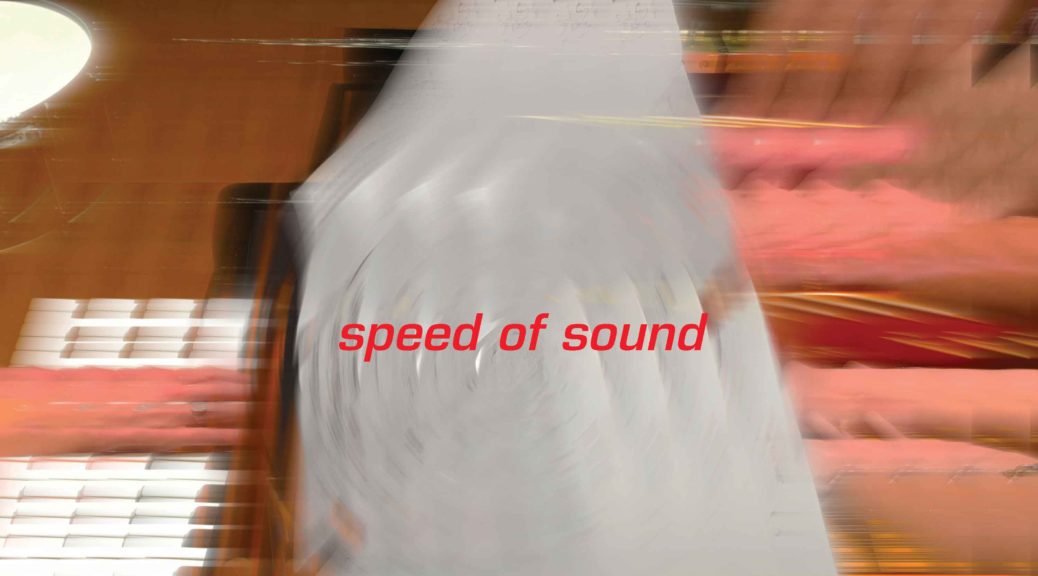
Speed of Sound celebrates both the Centennial of the McIntire Department of Music at the University of Virginia (UVA) and the Bicentennial of the entire institution. I-Jen Fang, the Director of the UVA Percussion Ensemble, curated this album, showcasing UVA composers and performers. These include faculty, as well as alumni, graduate and undergraduate students, with all of the music created between 2014 and 2017.
Awash depicts the life, color, and environment of the High Desert. The kinetic sound sculpture emanates audio from the region, while flowing as a singular mechanical wave overhead. Awash, like the High Desert, is shaped by many forces interacting in complex ways; the work is ecological – physical movement interacts with sonic vibrations. Sounds interact with the physical environment. Visual elements intermingle with acoustic elements.
The High Desert Museum commissioned Harmonic Laboratory for the work as part of its Desert Reflections 2019 exhibit. The exhibit went on to win the 2019 Charles Redd Center for Western Studies Award for Exhibition Excellence. Press release for the award.
Jon Bellona, electronics, software, field recording, Skinner church organ recording, sound editing, visual design, engineering
John Park, kinetics, visual design, engineering, schematics
Jeremy Schropp, field recording, visual design, engineering
Kevin Davis, Skinner church organ recording
Currents investigates the overlaps and gaps between noise and pattern; acoustic and electronic timbre; and live and fixed elements. Currents sounds out the intersections of our current electronic state while referencing its history. The piece was written for Tesla: Light, Sound, Color, a full stage production exploring the life and work of Serbian-American inventor, Nikola Tesla. Currents references Thomas Edison’s inefficient and noisy direct current (DC) electric motor and imagines the brilliant showmanship of Tesla and his revolutionary alternating current (AC) technology.
Distance-X is a digital musical instrument that consists of a hacked Gametrak, Nintendo Wiimote, and customized Kyma software. Music on Distance-X is all human-powered computer music. No tapes. No spacebar playback. Just body movements turned musical mutants.
Tesla: Light, Sound, Color is a 90-minute stage production with live physics demonstrations, digital animation, an original string and electronic musical score, and contemporary choreography. The project is the culmination of a 2016 Oregon Community Foundation Creative Heights award.
Hailed as a genius of the industrial age, Serbian immigrant Nikola Tesla continues to captivate the public with his electrical inventions that includes alternating current, contributions to radio transmission, the Tesla coil, as well as 280 other additional patents. The production brings Tesla’s enigmatic story to the stage by combining the science of his inventions with mixed media representations of his complex and tumultuous life. Harmonic Laboratory brings original artwork and broad collaborations together with content by Brad Garner, Jeremy Schropp, Jon Bellona, and John Park. Collaborators include: University of Oregon Physicist Stan Micklavzina, Delgani String Quartet, Eugene Ballet Company dancers, and visual artist Julia Oldham.
I composed six new original works for string octet (four violins, two violas, two cellos) and fixed electronics. One of the works, Currents, includes live Tesla Coils driven by MIDI messages. A second work, Broadcasting, uses FM transmitters to send audio to handheld radios carried by the eight dancers on stage.
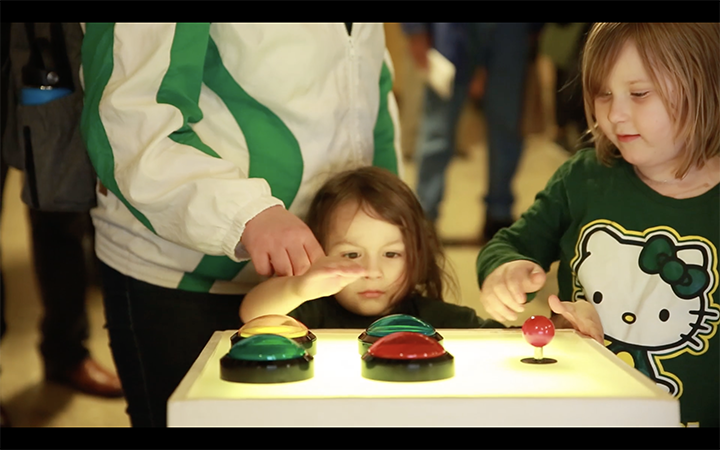
City Synth transforms the city of Eugene into a musical instrument. By transmitting video feeds from multiple locations to a central location downtown that interprets movement and color into sound, the cityscape becomes a soundscape. The project offers the community a playful way to learn about and interact with the gigabit network in downtown Eugene. The project was a month long installation housed in downtown Eugene, OR. Project partners include South Eugene Robotics Team (SERT) and XS Media. The project was funded by a Mozilla Gigabit Community Fund Grant.
Artists involved in the project:
Jon Bellona, sound design, coding, project lead
John Park, coding and visual design
Jeremy Schropp, interface design and construction