My son enjoys playing Bey Blades, which are spinning toys that bang and smash into one another within a plastic made arena. I spent countless hours with my son spinning away, where he often cajoled me into playing as a second whenever his friends were not available. Easily enough, I found myself immersed in his imagined world of Beys.
Typical play pits two Beys against each other in a “battle”, where the longest standing wins. Recording sounds from these toys during game play and descriptions my son gave of imagined sound worlds, I curiously followed his interest and the dichotomy between the real and the imaginary. These threads helped form the backbone of the piece, in which I travel back and forth between realistic game play and constructed hyper real sound of cinematic action/tournaments. “Let it Rip” intertwines the playfulness, competitive nature, and the theatre of these toys and their action.
Audio here is a binaural stereo version of the 7.1 multichannel work. Contact for programming the full fixed media work.
Performances
New York City Electroacoustic Music Festival (NYCEMF), June 25, 2026.
Society for Electro-Acoustic Music in the United States (SEAMUS), University of Texas, San Antonio, San Antonio, Texas, May 20, 2026.
Electronic Music Midwest (EMM), Lewis University, Romeoville, IL, Mar 13, 2026.
Future Music Oregon (FMO), University of Oregon, Eugene, OR, Nov 22, 2025.
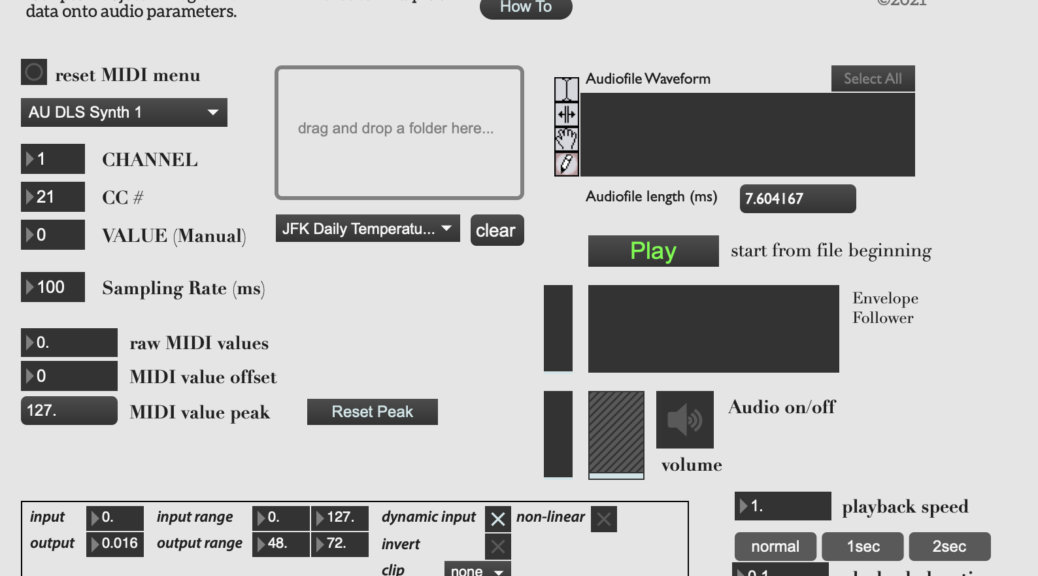
“Envelope Follower to MIDI CC” is a Max/MSP patch and stand-alone application for converting audio files into MIDI CC messages in real-time. Just load an audio file, play it, and you’ll be sending MIDI CC data based upon the amplitude envelope of the audio file. You have controls over MIDI data scaling, sampling rate, audio playback speed, and strict playback duration for mapping projects.
The impetus for the tool comes from not being satisfied with available options to convert audio amplitude into MIDI data for Digital Audio Workstation mapping projects. As a teacher, I wanted to create a resource to enable student mapping that leverages their own digital tools.
I made the software available as a repository on github. You don’t need to Max/MSP to run; I made a basic stand-alone application as well and the link is included on github.
If you dig the free software, please listen, share, and follow my music on Spotify.
Are streaming services ready for dynamic random-order concept albums?
Random Playback is a music album that explores using dynamically looped playback to generate a unique listening experience for your own device (and which never ends). The album leverages streaming technology to randomly playback material endlessly and aims to simultaneously test the boundaries of streaming services’ “gapless playback“ feature. Just hit shuffle, repeat, and play.*
*phone apps for Amazon Music and Apple services are the most seamless for shuffle playback.
UPDATE 9/21/21: While Spotify is seamless on chronological, non-shuffle playback, Spotify seems to falter if randomizing playback (confirmed by other users). Amazon Music Unlimited, however, seems to handle randomization playback well, nearly seamless (from the phone app). Apple Music also has seamless shuffle playback from the phone app. That said, any browser playback has terrible audio drops between songs on shuffle mode for all services.
The source material was generated and recorded with permission from playing an iOS clicker game, Rhythmcremental, created by Batta (Simon Hutchinson and Paul Turowski). Huge shout out to Simon and Paul. And do check out their game. It’s addictive.